My Thoughts About One of My Favorite Places--Northeastern Indiana's Amish Country

Friday, December 1, 2023

Welcome to my blog!

After ten years of blogging, I am no longer posting new material here, and much of my old material is now in book form instead -- three books for adults and two for children -- covers shown below.  

But there are still several dozen blog posts below -- including my posts on each of the sixteen Shipshewana Walldogs murals.

For information on my tours, books, and social media, go to my website, here.

Sue


Three books for adults


Written for "English" kids to introduce them to the Amish culture


Written for Amish kids about the history of the northern Indiana Amish community


Wednesday, October 18, 2023

Weaver's Produce Stand


Last week I took a bus tour group from Wisconsin around the Shipshewana area.  Since it’s fall at the moment, the tour director requested that apple cider be included in our day. 

 I’m not an apple cider fan, and I’ve never included that in a tour…  But my husband Gary said that Weaver’s Produce, on State Road 5 and 200 South, had good cider.  So off went Gary and I to check it out a couple of days before the tour.  I talked to the owner and told him we would be coming, and he was more than helpful. 

He said that he lives a little bit to the west on 200 South, but he rents this space because it’s on the main road.  He’s been at this location since 2011.  The stand is open from 9 a.m. to 5 p.m. every day but Sunday, and there’s plenty of good parking.

 The tour day came, and we stopped by with our big tour bus, which they helped our driver park off to the side.  Mr. Weaver had extra help on hand, so it didn’t take too terribly long to get everyone through the line.  He had also fresh-pressed some apple cider that morning to be sure we’d have enough to go around, so it was really fresh!  He even offered a drawing for anyone who spent over $20, and most of our folks did.  The winner got a box of fry pies, a local specialty.

This stand is known for its pumpkins, mums, and apple cider, but they have much more.  The small building had a variety of produce and locally made canned goods, and lots of other good things. If you’re looking for a break from all the sweets and baked goods Shipshewana is famous for, this is where you need to go.

Mr. Weaver said that his stand is open from mid-July until late October.  I highly recommend it.


Thursday, August 24, 2023

A Young Man With a Past

  This is the third of several Amish-related posts I wrote for my old genealogy blog...

* * * * * * * * * * * * * * * *


He was the last person I would ever have expected to be interested in genealogy—and what I found out about his roots was the last thing I would have guessed. 

It was late 2011 and I needed a new genealogy project.  My husband had mentioned my hobby at the manufacturing plant where he works, and one of the young factory guys asked him, “Do you think your wife could find out more about my family tree?”   Bruno (not his real name) was young, wild, and festooned with tattoos.  I was intrigued.  I decided to take on the project until my next paying client came along.  Bruno provided me with a few names and dates—that’s all he had.  He was particularly interested in his father’s ancestry, which he thought was German.   Perhaps he hoped for a few skeletons in the family closet.

A few days into the project, I came across the World War I draft card of Bruno’s great-grandfather Albert in Livingston County, Illinois.  I did a double-take when I read the answer in the space reserved for “Do you claim exemption from draft?  Specify grounds.”  Albert’s answer was “Religion—Mennonite Church.”

More digging connected me with the generation before that—and sure enough, before long I’d “struck Amish.” Others had blazed this particular trail before me, so at that point I was able to connect with the research of fellow genealogists who were willing to share… and so I was able to follow Bruno’s paternal line all the way back to a small village in Switzerland in the 1600s, where his 7th great-grandfather Peter had been part of a group of Anabaptists led by Jacob Amman himself—the original founder of the Amish church.

Bruno took some ribbing on the factory floor for all of this. “Chill out, Bruno—remember, you come from a peaceful people.” But he was happy to know more about his roots, and I was happy to be able to share the gift of such a wonderful and surprising heritage with a young factory guy from Ottawa, Illinois.

Thursday, August 10, 2023

Remembering Dad

 August 10, 2023

Today’s post is what I would call “off topic”—but I have a lot on my mind.  Thirty years ago today, on Tuesday, August 10, 1993, I said goodbye to Robert Milo Wallin—my dad. 

Dad died at 70, when I was just 38 years old, and not ready to lose him.

Being raised by a former army boot camp officer wasn’t always easy.  I took a lot of heat as the oldest child of parents who didn’t have children until their thirties (and didn’t have the best father and mother role models growing up)...  The pressure to excel in school was relentless, as was the pressure to deal with the food issues that have continued to dog me since infancy.  There were some great memories—but sometimes guilt and fear were the parenting techniques of choice.  By the time I went away to college, I was glad to be 650 miles away from the pressure at home.

But the wisdom that comes to twenty-somethings when they realize that they don’t actually know everything!—along with a year of therapy—resolved my anger and restored me to the parent who gave me so much of his own personality (as I’ve been told over and over through the years by those who knew him). I realized that Dad was only human, and doing the best he knew how to do—and that he truly, deeply loved me, as no one else could.  I thank God that I got twelve more years with him after that.

Courage.  Integrity.  Generosity. 

After Dad left us, I pondered what I most wanted to exemplify in my own life, that I had learned from his...  I have these three words written in the front of my Bible, and for all the years since Dad’s death, I have tried to live out these three qualities, as a way to honor his memory. 

Courage—I’ve always trusted my own instincts, as he did, and they’ve never let me down, even in risky situations...  Integrity—I’ve tried to live out my Christian faith as well as he did, in my financial life, my personal life, and on the job, handling the money for a million-dollar law firm...  Generosity—I’m still working on that one.  I can be selfish with my time and money, but I strive not to be. 

I just realized that these three words spell out the first three letters of “cigarette.”  Dad was a lifelong smoker, much to his own embarrassment, as he felt it was not a good Christian witness nor a good example to his own children.  But he started in World War II, where, he once told me, cigarettes were a part of their daily K-Rations in the front lines in France.  He said, “The cigarettes were necessary to calm our nerves, in order to do what they asked us to do.”  It’s a habit he wasn’t able to break—and forty years later, it killed him, as lung cancer took away his breath and then his life.

Dad used to say, “My job isn’t to raise happy children; my job is raise well-adjusted adults.”   That made me pretty annoyed as a teenager, but I can appreciate it as an adult.  I wish we’d had more years together!  I’d give almost anything to have even an hour with him now. 

My sister had a dream the night after Dad died.  In it, our family was walking across a big, open meadow, towards a beautiful castle on a hill.  Halfway across the meadow, we paused...  Then Dad continued walking towards the shining castle on the hill, and the rest of us turned around and began walking back the way we had come.  But I know someday I’ll walk that meadow, too, and see him again in a better place.  In the meantime, I’ll miss you, Dad.

In Loving Memory

Robert M. Wallin

January 23, 1923 - August 10, 1993


Thursday, November 10, 2022

The Bride Wore Purple: A Guest Post

It is my pleasure to share a guest post today!

This post was written by a fan of my Facebook page, Cindy Cosmo, describing the Amish wedding she attended recently.  I hope you enjoy her description as much as I did.

* * * * * * * * * * * * * * * *

The Night Before

Larry and I arrived in Shipshewana on Thursday, October 27, the night before the wedding. Vera (mother of the bride) called me on their outside phone…  When she found out we were staying the night, she invited us to come over that evening so she could show us around.  I'm so glad we went; we haven’t seen her or Clyde in three years and I wasn't sure if I would recognize her (or vice versa)!

Vera told me if I wanted to take pictures to take them that night, because it would be too hard to do them the day of the wedding. (The Amish do not like the English taking their pictures.) The dinner settings were set up in the banquet building and it was amazing! She told me they could fit around 400 people, so it was set up with very long tables and benches. (The benches, which are also used for church, are stored in a bench wagon; every church district has one.)


Gray plastic tablecloths with darker gray runners covered the tables, and sprinkled on the tables were flat back glass stones. Huge vases in the middle of the tables were filled with beautiful array of flowers. The plates and silverware were just gorgeous.

In an Amish wedding they have wedding wagons that come and family/friends to help with all the cooking. The china settings and silverware are rented.  I did take a couple of quick pictures of the tables; there was a red stepladder in the middle which of course would be gone the next day.  

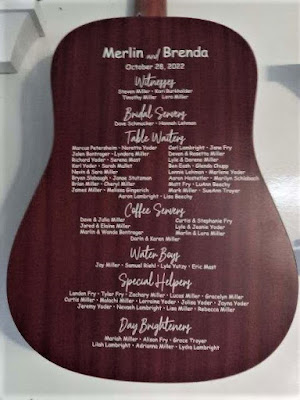
As I was leaving, Vera pointed out a guitar shape plaque on the wall with the names and the wedding date of Brenda and Merlin and also the names of the Table Waiters, Coffee Servers, Water Boys, Special Helpers and Day Brighteners—more about that later. Vera told me I could take a picture of it, which I did.

The Wedding Day

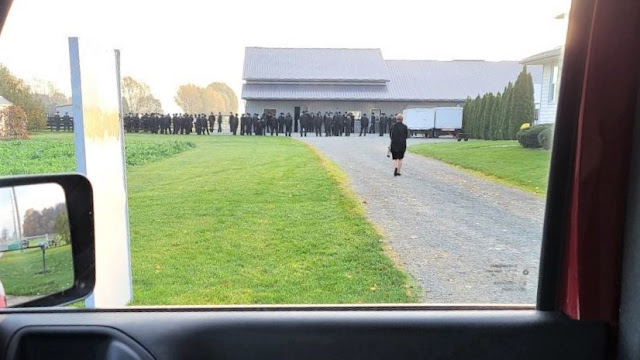
This was my first Amish wedding and it took place on Friday, October 28, 2022, and it was a wonderful experience!  Larry was invited, but he has been fighting a cold so he just dropped me off and took a distant picture as I was heading for the Amish church service/ceremony. There had to be at least 100+ Amish men standing and waiting outside.

I felt sheepish but I looked at one man and said, can I go in the building, and he said yes. As I entered, I saw that all the Amish women and children were already there. The women and the girls were dressed in shades of pastel blues, greens, brown, grey, and purple; one little Amish girl had on a bright yellow dress. All the women except the bride wore white caps, the bride had a black cap.

The young boys wore white shirts and had either black or grey pants with matching suspenders. The Amish men wore dark pants and coats with white shirts; they wear suspenders and not belts. The Amish men take off their hats and hang them outside before entering the building. 

In the Amish services, the men sit on one side and the women on the other.  When I entered, an Amish woman asked where I wanted to sit, and my reply was anywhere you want to put me. The woman said, would you like to sit so your back can be against the wall and I said yes—phew, that saved me from a backache!

Amish services are three hours long—you sit on backless wooden benches and it is all in a form of German called “Pennsylvania Dutch.”  There was supposed to be another English couple at the 9 a.m. service and three people from South Carolina were joining us at 10.  But the 9 a.m. couple never showed up, so for a good hour I was the lone Englisher in a church full of Amish people!

An Amish man came over and handed me a hymnbook, all in German. The service started on time, at 9 a.m. The ceiling was metal and they love to sing—so when they sang, the rafters almost shook!

I sat there and listened, holding the hymnbook, when two Amish women showed me the page, so of course I opened it up and stared at it—I don't know German. For the first two hours they sang, no talking. I found out after they sang for quite a while and then were silent for a minute, that it meant we were changing songs/pages in the book. So I was still on page 55 and when the next round started, the two women showed me we were on page 170—LOL!  

The future bride and groom and their witnesses came in around 10 or so. There were six metal chairs in front for the bride, who sat in the middle, and her two witnesses, who sat opposite of the groom and his two witnesses. The bride looked lovely wearing a purple dress with what I believe is called a white cape with an apron over her dress, with a black cap, stockings and shoes. Her two witnesses were dressed in matching gray dresses.

Around 11, the servers and the cooks came in the building.  There were 15 empty long benches reserved for them, and they filled all of them.

Several large bowls of candy were passed around at that time for the children—and seeing the smiles on their faces, you could tell they really enjoyed the treat.

The father of the groom started to speak in front of the couple and the witnesses.  Since it was mostly in Pennsylvania Dutch, I didn't understand what he was saying, but every so often an English word was said, so I kind of got the gist of it—he welcomed Brenda to the family. He spoke at least 20 minutes and then another minister spoke.  After that the Bishop performed the ceremony, which was short, I think less than 10 minutes. It was serious—no  flowers, no wedding rings, no kisses or clapping for the newly married.

Soon afterwards, the servers left, then the bride and groom’s families left, then Brenda and Merlin, and then all of us. I was quite impressed that the children were so well behaved and when it was time for prayer—silence. Some people were surprised when I told them that the three hours actually went fast—maybe because of all the singing they did, which was beautiful to hear and listen to—or maybe it was just the experience itself, but it the time did go by quickly.

After the Ceremony

It was a beautiful day—the sun was shining and other than being a little nippy in the shade, you couldn't ask for a more perfect day for a wedding!  I was standing outside with Vera’s sister, waiting until we would all go in to get seated for the meal. Vera’s sister told me that the bride, groom, and four witnesses were inside her parent’s house.

When they came out, Merlin’s young niece threw rose petals on the path they were walking on. Brenda now had a white cap on instead of the black cap, meaning she was now a married woman.  Before the men get married, they do not have beards, but now Merlin will be growing his. Young children were opposite each other on the path, and as Brenda and Merlin went by, the children handed them a single rose—it was cute and quite touching to see.

I mentioned above about Day Brighteners on the guitar plaque. Brenda and Merlin decided to give the small children a part in the ceremony, passing out the roses to the bride and groom, and they wanted their names mentioned on the plaque.

We finally gathered in the banquet hall…  The Amish men were seated first, followed by the women and the four English people who attended. We Englishers sat across from some Amish women and when we asked some questions, they were very nice and helpful.

Before luncheon was served, they sang “Gott Ist Die Liebe,” which translated is, “God Is Love.”  Afterwards we were all talking when a prayer was about to be said—and suddenly, just like that, the whole room was quiet—I was very impressed!

Now the luncheon was being served.  The first thing that was passed around the table was a small piece of wheat bread with homemade marmalade jam and butter; followed by meatballs; stuffing; green beans; homemade mashed potatoes with rich gravy; and cornbread casserole. We had water and coffee with our meal.

Before long, a second round of food came our way and then finally the dessert. I didn't see a wedding cake but they had some mighty good desserts and of course I had to take a little of everything! There was pecan pie; cream pie; blueberry pie; and homemade ice cream and raspberry sauce.

As we were eating, a young Amish boy came to all the tables and we all got a pen with the names of the bride and groom and the date they were married to take home. Just after we finished eating, a huge bowl of candy was passed around.  I was “stuffed,” but I took some candy for my husband.  As we were exiting, we passed by the couple’s table and shook hands and congratulated them.

I forgot to mention that when I got the invite, I was asked if I wanted to go to the noon or the 4 p.m. seating. I later found out that they were having two more seatings that day—one at mid-afternoon (this was for the servers and cooks) and I think the last one was at 7—that was for the younger people.

I was also told that the bride and groom stay at the bride’s parents house the first night, so they can help with the cleanup the next day. Everything had to be cleaned quickly since the wedding wagons would leave around 10 a.m. Weddings are usually on a Tuesday and Thursday, but because there are so many, other days are used too (with the exception of Saturday and Sunday).

 Opening the Gifts

Another tent was set up outside where the bride and groom had their gifts. The other English people left, leaving me the only English person there. I have read that in some parts of the Amish community, only Amish are invited to the gift opening, but I was told I could go in, and I wanted to experience it all, so I followed the woman that I was talking to.

As soon as I entered, Vera saw me and invited me to sit with her up front—we had a nice chat. The bride and groom opened their gifts but did not pick them up or say what it was or who it was from—but I could see everything so that was fine.

While doing this, the Amish men once again sang. I asked Vera if that was religious and she sort of nodded and said it was a wedding song. The gifts they received were practical and things they would need for the household, and Merlin also received some tools. The gifts were mostly wrapped in towels or blankets which was a good idea and certainly wouldn't go to waste.  I was working on an afghan to give them but being self-taught, I wasn't happy with one edge and I didn't complete it in time, so Larry and I decided to give them a gift certificate to Blue Gate Restaurant.

It was after 3 p.m. and they still had gifts to open so I finally texted Larry and said I would be ready in ten minutes. I saw Vera and she thanked me for coming, along with a few other Amish women I met… but I felt like I should be thanking her, since it was probably a once in a lifetime experience and I was honored to be invited.

A Few More Photos 

As I waited for Larry, I wanted to take pictures, but I was leery because I know how the Amish feel about taking photos of them.  I tried to be careful, but I did get some of the kids playing volleyball from a distance.  I sort of hid trying to get pictures of the hanging towels.  


*** text and photos courtesy of Cindy Cosmo ***


Wednesday, April 15, 2020

The Heritage Trail


Things have been a little slow as of late, so the husband and I decided to do something I’ve had on my back burner for years:  Drive the Elkhart County Visitor Center’s “Heritage Trail.”  I had a copy of the map and 2-CD set, so why not give it a spin?


We drove from our new home in Middlebury to the Elkhart County Visitor Center (ECVC) near the tollway, and started from the beginning, driving clockwise through Elkhart, Bristol, Middlebury, Shipshewana, Goshen, Nappanee, Wakarusa, and back to Elkhart.  Three hours and 95 miles later, we were back around to the beginning.

One important note—the ECVC has changed locations since this map and CD set was created!  It is still near the Cracker Barrel, but in a different building, at 3421 Cassopolis Street now.

The two CDs gave very nicely detailed instructions for each turn—and there were dozens!  We found it took two of us to navigate the trail, and even then, we missed a few turns.  We spent about half our mental energy on this task alone!  The map was less helpful than it could have been—in the towns, particularly Elkhart, a more detailed, close-up map was sorely needed to find all the many twists and turns not shown on the big map.

Much history of the area was given along the way—the businesses and industries, mainly, and famous residents.  (Take note—very few of the trail’s total miles go through “Amish Country,” and most of the places that they do are in Lagrange County, not Elkhart County.) 

Highlights:

Elkhart:  Follow the CD here, not the map, and listen closely!  The route goes along the St. Joseph River and gives the general history of Elkhart.

Bristol:  There were six stations of the Underground Railroad around the Bristol area—who knew?  The Elkhart County Historical Museum is there.  It is one of many suggested stops along the trail.  By stopping at these suggested places, as well as stopping for food, the entire Heritage Trail could take several days to complete, rather than three hours.

Bonneyville:  The history of Bonneyville Mill (still open to tourists a few days a week) and its very colorful founder Edward Bonney are the main focus here.

Middlebury:  Approaching Middlebury, the Amish are first mentioned on the CD, but few Amish farms are to be seen in this part of Middlebury.  Suggested stops here include Krider Garden, Essenhaus, and Jayco (they give tours).

Lots of information about the Amish culture is given on the CD starting at this point—most of it accurate.  (Exceptions I noticed included:  (a) weddings are not held just after harvest time, and not only on Tuesdays and Thursdays; (b) there is some limited use of tractors by the Amish these days; and (c) half of local Amish kids are no longer in public schools—nearly all of them are in Amish one-room schools now.)

Shipshewana:  This is the only heavily Amish area on the tour, and very little time is spent here.  (Shipshewana is actually not in Elkhart County, but in Lagrange County.)   Suggested stops for those who want to make the tour a multi-day experience include the downtown shopping district, the 50-acre Flea Market (open seasonally), and the Menno Hof museum, as well as Yoder Popcorn – south of town on this tour, but soon to move to the corner of Routes 5 and 20 in Shipshewana.

Goshen:  It’s a long drive to the next town—Goshen—and some of the scenery is pretty.  Much history of Goshen is given, highlighting the Old Bag Factory, a suggested stop.

Nappanee:  Nappanee is the home of the former “Amish Acres,” now morphing into “The Barns at Nappanee” under new ownership.  The Amish are mentioned during this part of the tour, but very few of their homes or businesses can be seen from the Heritage Trail.

Wakarusa:  This is a small town north of Nappanee and south of Elkhart.  It is home to a maple syrup festival in the spring, and much info is given about the maple syrup making process.  It is also home to the old Wakarusa Hardware Store and the Wakarusa Dime Store, home of the jumbo jellybean—a suggested stop.

Elkhart:  Driving north back into Elkhart, more information is shared about the history of the Elkhart area, including the railroads and the band instrument industry, as well as the charming story of “Curly Top,” a little girl who became famous for waving at the train as it went by.

In summary, this tour might be good for someone who is a museum/history buff, since it’s heavy on the [non-Amish] history of Elkhart County—spend three hours or three days!  But for Amish culture and history, I’d stick to Lagrange County instead, particularly the Shipshewana area—and read my blog posts for places to go and things to see.  Hmmmm… maybe I’ll design my own road tour!

Wednesday, November 20, 2019

Window Stickers


Recently my husband Gary drove half a dozen Amish young people to a wedding in Lancaster County, Pennsylvania.  This is an unusual occurrence; not much intermarriage happens between the Amish here in northeastern Indiana and the Amish in Lancaster County.

He had a few hours to wander around, and he found himself at the Weavertown Coach Shop, where Amish buggies have been made for almost fifty years.  Notice, you can take your horse through the “horse wash”!  (Gary looked around to try and get some photos, but the horse wash was closed.)


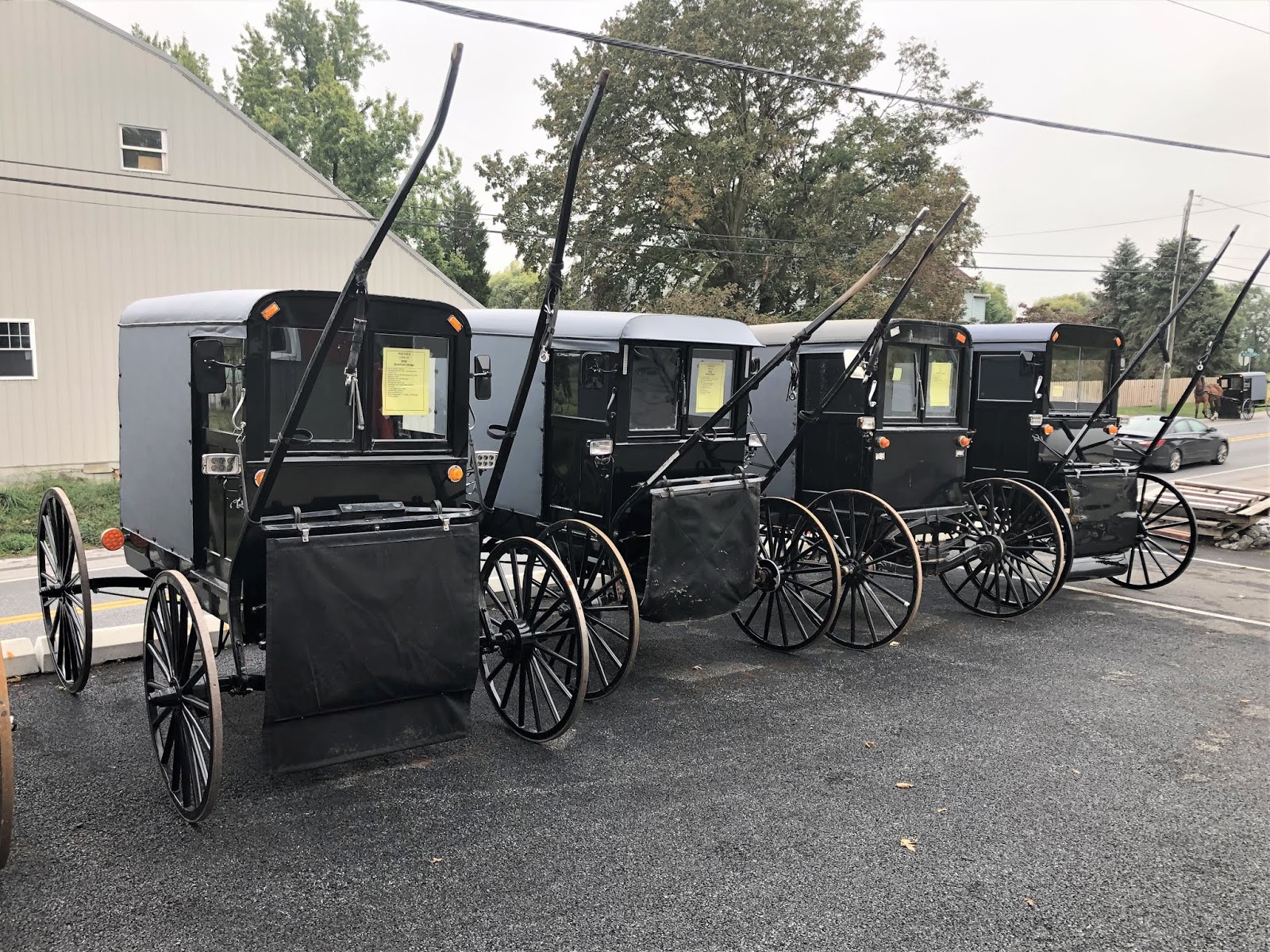
Gary took the photo below of the buggies in the lot.  Notice the difference between these rounded, gray buggy tops and the angular, black buggy tops seen in northeastern Indiana.


Below is the “window sticker” for a 80%-new, rebuilt buggy which can be had for $7,995.  (A new one would cost $10,140.)  The buggy has a one year warranty.  Buggies can have thousands of dollars of options and upgrades.  Notice the options listed here, which include a fiberglass body—most of the buggies in northeastern Indiana have a wood body.  This one has upgraded brakes and a swirl navy interior with shag carpeting.


Smaller budget?  Try this older buggy, below, for $2,995.  It is being sold “as is, decent condition.”  It’s a nice buggy, similar to the first one, but probably quite a bit older.


 Some of the local buggies resemble pickup trucks, with an open back for cargo.  (Gary calls them “Amish El Caminos.”)  He took this brief video of one of them:


I’ve written about the Amish buggies in northeastern Indiana, here.


Monday, August 12, 2019

Riding in a Cruiser


Took my first ride in a cruiser the other day - an open buggy - kind of a new thing around here in the last ten years...  It is the best way in the world to see the countryside!  Drove down to Topeka-town with my best friend Ruth, had pizza, and drove back.


I recently wrote about cruisers here.

Monday, April 29, 2019

A Porch, But Not Really


I saw this "porch" on the edge of an Amish garden patch the other day... It's actually just the plain metal side of a barn, but a false porch was created!

The false door says, "He who plants a garden works hand in hand with God."

Monday, March 19, 2018

The Westview Warriors


It's the tail end of basketball season, and in Amish Indiana, that can mean only one thing in the Shipshewana community:  Westview Warrior fever.

Even the Amish are followers of the local consolidated high school and their excellent basketball program.  Those English farm boys can play!

Here's a video:

Monday, August 15, 2016

Hope - Trust - Believe

Seen recently on an Amish farm in Goshen, where I was taking photos of a bench wagon for an upcoming post... This little shed:


Friday, January 29, 2016

Jelly, Jam, Preserves, Marmalade

Seen at Yoder's Meat & Cheese in Shipshewana today - this helpful sign:


Tuesday, March 24, 2015

Shipshewana Walldogs, Part Sixteen: M. Y. Miller General Merchandise


For the last of my series on the sixteen murals painted by the Shipshewana Walldogs in summer 2014, I took a closer look at the M.Y. Miller General Merchandise mural.  This one can be found on the north side of the Forks Grocery building on State Road 5, and it is the northernmost of the murals.

Who was M.Y. Miller?  I thought I might have trouble with this one, since “Miller” is such a common name in the area.  But since the mural showed the year “1925” on the calendar, I went to ancestry.com and started with the 1930 census.  And there he was, Mahlon Y. Miller. 

In 1930 Mahlon Y. Miller, age 42, and wife Bessie lived with 7-year-old son Robert on Morton Street in a home they owned valued at $1000.  His occupation was “proprietor, general store.”  He is listed as a World War One veteran, which led me to look for his draft card.

Mahlon’s 1917 draft card says he is 30 years old and medium in height and build, with brown eyes and dark brown hair.  He was born in Lagrange County, Indiana in 1887.  His occupation was clerk in the general store of J.E. Sunthimer, who was the subject of another post in this series.  He claimed exemption from the draft due to a dependent, his wife.  But he was drafted anyway, as the May 18, 1918 issue of the Fort Wayne News & Sentinel reported that he and seventeen other local boys were headed for Camp Zachary Taylor, Kentucky for training.  So, when was he married?

I next found an Indiana marriage record.  Mahlon was married to Miss Bessie Alberta Nelson in November 1910.  So, Mahlon should be on his own in the 1910 census and married in the 1920 census.

Sure enough, the 1910 census shows Mahlon living with his parents, Yost and Elizabeth, and his younger siblings.  He is 23 and works as a clerk in an unnamed grocery store.  It appears Mahlon was destined for the retail trade from his youth.

The 1920 census shows Mahlon working as a clerk in the Sunthimer store, now being run by J.E.’s son Charles after his father’s death.  Mahlon and Bessie own a house on Middlebury Street, right next door to Mahlon’s boss, Charles Sunthimer.  So, Mahlon opened his own store some time between the 1920 census and the date of 1925 shown on the mural. 

The 1940 census tells us that he is still the operator of his own general store, where his wife Bessie is the clerk.  It’s not an easy life; the week before the census, Bessie put in 30 hours, but Mahlon put in 78.  And in 1939 he worked 52 weeks, so there were no vacations. But he and Bessie and son Robert, now 17 and still in school, had a good life; they owned a home worth $1,600 on Morton Street and lived in the same neighborhood as such entrepreneurs as W.L. Reifsnider and Edward Wolfe.  Not bad for a man with (according to the census) only an 8th grade education.

Mahlon appears in one more record—his World War Two draft card in 1942.  At age 55 he still has a store in Shipshewana.  He is 5’10”, weighs 185 pounds, and has brown eyes and gray hair.  His nearest relative is his wife Bessie.

Findagrave.com tells us that Mahlon lived to a ripe old age, passing away at age 88 in 1975.  He is buried at Scott Cemetery with his wife Bessie, who predeceased him.


Thank you, Walldogs, for your beautiful work in Shipshewana.  I’m glad I was able to be there to watch you at work.  Your sixteen murals are a wonderful addition to one of my favorite places in the entire world.


Thursday, March 12, 2015

H.E. Bucklen, Medicine Man and Real Estate Tycoon

In my last post, I talked about the Shipshewana Indians baseball team of the early 1900s, which is pictured on one of the Shipshewana Walldogs murals.  The founder of the team, Mr. H.E. Bucklen, had such an intriguing story that I decided not to skimp on it, but save it for another day—so here it is.  It’s my longest post ever, but there’s a lot to tell—and I’m just hitting the highlights!


Bucklen’s full name was Herbert Elijah Bucklen, Sr.  I searched for details about Herbert and his family on ancestry.com, and there was plenty to discover!  Articles from newspapers.com supplied even more details.  This man had a huge paper trail.

Herbert was born in Herkimer County, New York in 1848, but the family relocated to Coldwater, Michigan in the 1850s.  By late 1860 they lived in Elkhart, Indiana and at the time of the 1870 census, Herbert, age 22, was a druggist alongside his father, Isaac Bucklen. 

A biography of Bucklen appeared in The Indianapolis News (8/16/1902).  In it, Bucklen says that he began buying real estate and building small homes when he was a teen, reinvesting the profits in real estate—and by the time he was twenty, he owned 32 houses in Elkhart.  At the same time, he says, he worked in the back room of his father’s pharmacy developing his own special patent medicine—“Bucklen’s Arnica Salve.”  Herbert married a Michigan girl named Bertha Redfield in 1877, and obtained a patent for his salve in 1878.  He and Bertha then moved to Chicago, where he sunk his patent medicine earnings into real estate in the growing city.

The newspaper ads for Bucklen’s Arnica Salve were really something!  I went to newspapers.com and found at eight of them which ran between 1908 and 1911 in various Indiana papers.  Set up like little newspaper articles, they contained such headlines as “Best Healer in the World”—“Frightful Fate Averted”—“It Does the Business”—and “Suffering and Dollars Saved.”


The ads claimed the salve would cure cuts, corns, bruises, burns, boils, ulcers, eczema, old sores, cold sores, fever sores, scalds, scars, cracked lips, chapped hands, chilblains, sore eyes, skin eruptions, salt rheum, gangrene, pimples, and let’s not forget “piles” (hemorrhoids)!  And for the ladies—“Women desiring beauty get wonderful help from Bucklen’s Arnica Salve… It makes the skin soft and velvety.  It glorifies the face.”  Well worth the 25 cents!

Happy users gave testimonials like this one from Frank Disberry of Kelliber, Minnesota:  “I would have been a cripple for life from a terrible cut on my knee cap without Bucklen’s Arnica Salve, which soon cured me.”  Or this one, from Rev. F. Starbird of East Raymond, Maine:  “I have used Bucklen’s Arnica Salve for several years on my old army wound… and find it the best healer in the world.  I use it too with great success in my veterinary business.”  Piles sufferer L.S. Napier of Rugless, Kentucky reported that “when all doctors and other remedies failed, Bucklen’s Arnica Salve cured me.” 


By the 1900 census, Herbert lived at 265 Michigan Avenue in Chicago with his wife and three children.  No occupation is listed.  In 1910, he lives at 281 Wabash with his wife, younger son, and a maid.  Again, no occupation.  But that area of North Michigan and Wabash Avenues was a very wealthy neighborhood, both then and now.  This building (pictured below) was both his home and laboratory facility.


By then Bucklen owned real estate in Chicago, zinc mines in Missouri, gold mines in Colorado, and a great deal of land in northern Indiana—especially Elkhart, where he built a grand opera house in 1884 (shown in this photo) and remodeled a magnificent hotel in 1889.  (Neither building still stands.)  Although Bucklen’s primary residence remained in Chicago, he had a strong presence in Elkhart.  He considered it his true home, and he was listed in its city directories—“occupation, capitalist.”  He sent his son Herbert Jr. to nearby Howe Military School.


 Another of his pet projects was the St. Joseph Valley Line Railroad, built in 1904-1905.  (This was a different railroad line than the more famous Pumpkin Vine Railroad, which ran north from Shipshewana into Michigan.)  The St. Joseph Valley Line was a “traction line” that started in Elkhart and ran east through Bristol, Middlebury, and Shipshewana to Lagrange.  Later a “railway line” extended the Valley Line east from Lagrange through Mongo, Orland, Inverness, Angola, and Berlin to Columbia, Ohio—a total of 70 miles in all.  The section from Elkhart to Bristol operated on electricity; from Bristol to Lagrange by gasoline engine; and from Lagrange to Columbia by steam engine.

When Bucklen was extending his railroad line eastwards from Lagrange to Ohio in 1905, he suggested to the residents of Angola, Indiana, that this would be a boon to their small community.  The millionaire asked the residents for $50,000 to help him with the project.  When they didn’t come up with the money, he was so offended that he decided to build a rival town.  An article in the Fort Wayne Journal-Gazette (11/24/1912) said that the “Arnica Salve King” was planning to “build a city in Steuben County with the express purpose of injuring Angola, against which town he has conceived a grievance.”  But the railroad line did run through Angola, and the rival town (eight miles east of Angola) evidently was never built.

The railroad line was not nearly as profitable as Bucklen hoped—in fact, it lost a lot of money.   Running three kinds of power was complicated and expensive.  Business at the west end was very slow.  Bucklen poured large amounts of his own money into the project to keep it alive, but it was estimated by the Indianapolis News (4/4/1918) that he lost $1,750,000 on the project.  

Out of this interest, he was involved in the area baseball league which included the Shipshewana Indians, who played at a stadium he built on the south side of Shipshewana Lake.  An article in the Indianapolis News (5/30/1905) says, “Mr. Bucklen has prepared a plat for a summer resort at Shipshewana Lake, with streets and avenues and winding drives through the woods.  The resort is expected to attract many Elkhart people who have heretofore spent much time in Michigan.”  Special railroad cars brought fans to the baseball games on Sundays.

At one point Bucklen’s assets were thought to be worth $7,000,000, but when he died in 1917, he left his widow an estate which the Chicago Daily Tribune valued at $1,000,000.  (That would be equal to $17,000,000 today—still a nice chunk of change!)  Due to the popularity of his Arnica Salve, his death was reported in newspapers as far away as Honolulu. 

His wife Clara inherited her husband’s assets—but the Valley Line, managed by their son Herbert Jr., was already in financial trouble which only got worse as 1917-1918 progressed.  A severe winter, a drop of freight traffic, and a wreck in Inverness which produced serious injuries and fatalities were the final blows.  (The advent of the automobile probably didn’t help, either.)  The rail line soon went into receivership in preparation for being both legally and literally dismantled and sold for scrap.    

Bucklen’s funeral was held in Elkhart, and he was buried at Half Acre Cemetery in Cass County, Michigan, along with his wife Bertha.


Images:  slideshare.net; tomboyglam.ecrater.com; oldnews.aadl.org; bottlepickers.com; elkharttruth.com.


Tuesday, March 3, 2015

Shipshewana Walldogs, Part Fifteen: The Shipshewana Indians


This wonderful mural, “Shipshewana Indians,” is found on the side of the Mishler building, in downtown Shipshewana on Morton Street.  Words on the left side say “Every Sunday Afternoon at 2 p.m.” and on the right, “St. Joseph Valley Line – Take the Train to the Game!”  It also says “Est. 1906.”  But even with these clues, I was unable to find any information about the baseball team online.  Luckily, I was able to contact Al Yoder of the Shipshewana Area Historical Society for help.

Mr. Yoder told me that the baseball team was formed from all local players by an Elkhart businessman, a millionaire named H.E. Bucklen.  Mr. Bucklen owned a hotel in Elkhart as well as having investments in Chicago.  He built a railway (the St. Joseph Valley Line) which started in Elkhart, ran east through Shipshewana (south of Shipshewana Lake), and then onwards east to the Ohio state line.  Near Shipshewana Lake, Bucklen built a resort—with a baseball field and stands.

The Shipshewana Indians played their games on Sunday afternoons, as the mural says, and fans came from Elkhart, Lagrange, and all points east.  The Valley Line Railroad ran special cars to accommodate the crowds.  During the games, the railroad cars would sit on a side track near the sawmill in Shipshewana, and then after the game, they would go back to pick up the fans.

The teams of 1907-1909 were especially talented, Al told me.  Fans came from all over northern Indiana and southern Michigan to see them play.  They played teams from neighboring towns like Goshen, Elkhart, and nearby Sturgis, Michigan.  All the players were local lads.  Some of the best were Pete Fahrer and Harry Eash (pitchers); Claude Lupold (catcher); Vern Butts (1st base); James Beecher (2nd base); Leo Hersberger (shortstop); Samuel Curtis  (3rd base); and lastly, Burns Summey, Clifford Sixby, and Jim Lemerck (fielders).

With this information from Mr. Yoder, I was able to do a little more digging.  First of all, I wondered about H.E. Bucklen and his railroad.  (This was a different railroad line than the Pumpkin Vine Railroad, pictured in another Walldogs Mural and written about in another of my posts.)  There was so much to H.E. Bucklen’s story, that I’m saving it for another day. 

Who were these young men on the 1907-1909 Indians baseball team?  I decided to check the 1910 census records and the 1917 WWI draft records to find out.

·       Pete Fahrer (pitcher):  His name was really Clarence.  In 1910 he was 20 and was a baker in a restaurant.  By 1917 he was a farmer in Newaygo County, Michigan.

·       Harry S. Eash (pitcher):  I couldn’t find him in 1910, but in 1900 he was 12 and a farmer’s son, so in 1910 he would have been 22.  By 1917 he was a theatrical manager in Dodge City, Kansas.

·       Claude Lupold (catcher):  His first name was actually “Cloid”!  In 1910 he was 26 and a farm laborer on the home farm.  In 1917 he was a farmer, still in the Shipshe area.

·       Vernon R. Butts (1st base):  In 1910 he was 26, separated from his first wife, and living with his parents; he was a carpenter.  By 1917 he was remarried and worked in the Shipshe area as a locomotive fireman.

·       James A. Beecher (2nd base):  In 1910 he was 24 and worked as a miller at a flour and feed mill.  He was married with a 5-year-old son.  By 1917 he was a salesman for the Anthony Wayne Institute in Fort Wayne.  He was sent to Fort Benjamin Harrison Officer Training Camp that year, but failed the physical.

·       Leo D. Hershberger (shortstop):  In 1910 he was a 20-year-old public school teacher, having graduated from the local high school in 1907.  By 1917 he was a Methodist minister in a nearby town.

·       Samuel P. Curtis  (3rd base):  In 1910 Samuel, age 25, lived with his brother and they both worked in a meat market.  By 1917 he was a farmer in the area.

·       Burns H. Summey (fielder):  He graduated from the local high school in 1907.  In the 1910 census he was 21 and worked in a butcher shop.  In 1917 he was still working locally as a butcher.

·       Clifford F. Sixby (fielder):  In the 1910 census Clifford was the manager of a restaurant and 27 years old.  By 1917 he was a farmer in Newaygo County, Michigan.

·       Jim Lemerck (fielder):  His name was actually James G. Limric.  In 1910 he was 30 years old, married, and a plumber.  By 1917 he worked at the Smith Brothers Hardware Store in Shipshewana, in the plumbing/tinning department.

A look at newspapers.com didn’t turn up much, but I was able to find out that their home field was called “Lakeside Park.”  An article from Shipshewana in the Fort Wayne Journal-Gazette (7/11/1911) said, “A large number of fans from here gathered at Lakeside Park yesterday to witness the game between the Lagrange and Shipshewana teams.  The game was one of the best seen on the local lot this season but at no time was the outcome in doubt as Fahrer, pitching for the local team, had the visitors at his mercy throughout the game.”  I also learned that in September 1909, Goshen had won the independent baseball championship of northern Indiana and southern Michigan by beating Shipshewana 18-3 (Indianapolis News, 9/20/1909).

The Walldogs mural says that the team was established in 1906, which makes sense, given that Mr. Bucklen laid plans for his lakeside resort in 1905.  I was unable to find out when the team stopped playing, but perhaps World War I put an end to it.  Or maybe the fact that the railroad line that brought the fans was sold and scrapped in 1918 had something to do with it.  I would love to know more about the team and the baseball field and the resort on the south side of Shipshewana Lake.


Tuesday, February 24, 2015

Shipshewana Walldogs, Part Fourteen: Amish Heritage


One of the sixteen murals painted by the Walldogs in Shipshewana during June 2014 was this one, with the simple message “Amish Heritage.”  It can be seen on the north wall of Spector’s, a fabric store on State Road 5 which is frequented by the Amish.

The mural says that the Amish “first settled in this area 1841.”  Having done a lot of genealogy research for my Amish friends and written about it on my former genealogy blog, I’m familiar with the history of the Amish in this area of Indiana.  But I looked into the subject a little further to be sure I had my facts straight.

Indeed, as the mural says, the Amish first came to Lagrange and Elkhart Counties in the 1840s, mostly from Somerset County, Pennsylvania.  (These were the "Dutch Amish, who had come to Pennsylvania from Europe in the 1700s to escape persecution, and then moved westward into Ohio and then Indiana in the early 1800s.) 

For more details, I turned to the book History of Lagrange County by F.A. Battey & Company, published in 1882.  I liked having history from the viewpoint of those who might have been alive when the first Amish came.  And this book would have been written at a time when the non-Amish were just as “horse and buggy” as the Amish, so the differences would have been more subtle.

The first Amish settlers in the Newbury Township (later Shipshewana) area, according to the book, came to Newbury Township in 1844.  Brothers Daniel and Joseph Miller came on a scouting tour from Somerset County.  They liked it and immediately purchased farms.  Soon they were joined by Christian and Joseph Bontrager.  More German “Dutch Amish” followed, along with some of their brethren from Holmes County, Ohio.  John C. Yoder was another early Amish settler and patriarch.  The book says he was called “the doctor”—“on account of his skill in healing some of the human ills.” 

The book goes on to say that “This branch of the church [the Amish], which is distinguished by a strict observance of all the old customs, has a large membership among the Germans, who now occupy almost the whole of Newbury [Township]...  each district has its Bishop and two ministers.  The Bishop alone can perform the rites of baptism and marriage.”   The book also says this: 

“The peculiar characteristic of the church is a literal observance of every injunction of the Scriptures…  There are no meeting-houses, but they meet in the homes of the members; no written creed is used by the church; the apostolic rite of feet-washing is observed…  But the most obvious characteristic is that no ornament of any kind is tolerated on the person, nor in the way of paint or plaster in the houses, nor any brilliant coloring about the buildings…  As no conformity to the world is allowed, something like a German peasant costume is still used, and as buttons are under the ban, hooks and eyes supply the necessary fastenings…  German is also spoken continually in their home life, and this is another ‘tie’ and distinction from ‘the world.’”

The authors (members of the Lagrange County Historical Society) seemed to have a high respect for their Amish neighbors, as distinctive as they were even in 1882.  They go on to say, “A marked degree of morality pervades these people…  Financially they are prudent, frugal, and successful.”


The Amish thrived in Lagrange and Elkhart Counties, and today their settlement there is the third largest Amish settlement in the United States.  (There are no Amish settlements in Europe in modern times—only North America.)  Their numbers in have risen to over 14,000 in Lagrange County alone, as of the 2010 census—and although they mainly keep to themselves, they are good neighbors, good businessmen, and good citizens, and—for my husband and I—good friends.